
5 Pricing Factors Behind Commercial Duct Cleaning Cost
When a commercial HVAC system needs attention, the first question most business owners and facilities managers ask is how much it will cost. Understanding commercial duct cleaning cost before requesting quotes protects you from lowball bids, unrealistic expectations, and services that cut corners to hit an artificially low number. Pricing varies significantly based on factors specific to your building and your system. Knowing what a thorough commercial HVAC cleaning actually involves gives you the context to evaluate any quote accurately and make an informed decision.
In this guide, you will learn:
- Why commercial duct cleaning pricing varies so widely between providers and buildings
- 7 specific factors that directly drive commercial duct cleaning cost
- How to read and evaluate a commercial duct cleaning quote before signing anything
- What red flags in a low bid actually signal about the quality of service
- How to calculate the long-term return on a commercial duct cleaning investment
- What questions to ask any provider before committing to a service agreement
Why Commercial Duct Cleaning Cost Is Not a Simple Number

Business owners who approach commercial duct cleaning the same way they would approach a residential service often find themselves confused by the wide range of pricing they encounter. A quote for a small office suite and a quote for a multi-floor commercial building can differ by thousands of dollars for legitimate, fully defensible reasons. The complexity of commercial HVAC systems, the variety of building configurations, and the specific contamination conditions inside any given duct network all produce pricing outcomes that simply cannot be standardized the way residential pricing often can.
For businesses in Fripp Island and surrounding areas, where commercial properties range from boutique hospitality spaces to larger mixed-use facilities, understanding what drives commercial duct cleaning cost is the difference between making a smart maintenance investment and either overpaying for underperforming service or underpaying for work that leaves the system in worse shape than before. Here is what every business owner needs to understand before requesting their first quote:
- Cost Reflects System Complexity, Not Just Size: A 5,000-square-foot facility with multiple HVAC zones, rooftop units, and specialized exhaust systems for kitchens or server rooms will cost more to clean than a 10,000-square-foot open warehouse with a single air handler, even though the warehouse is physically larger. Complexity drives cost more than square footage alone.
- Low Bids Often Signal Incomplete Work: Providers offering unusually low commercial duct cleaning rates frequently achieve those prices by cleaning only the visible register areas or by skipping the return side of the system entirely. The sections of ductwork that are hardest to access are also the sections where the most significant contamination accumulates, and cutting corners there produces a result that looks clean at the register but remains heavily contaminated throughout the rest of the network.
- Deferred Maintenance Increases Future Cost: Buildings that have not had their duct systems professionally cleaned in several years typically require more labor hours, more aggressive cleaning approaches, and more time per unit of ductwork than a system receiving routine maintenance. Deferred cleaning is always more expensive than scheduled maintenance, and the gap in cost grows with each year of neglect.
- Compliance Documentation Has Value Beyond the Cleaning: Many regulated industries require documented evidence that HVAC maintenance has been performed. A professional commercial duct cleaning service that provides before-and-after photography, written service reports, and component condition notes gives businesses compliance documentation worth well beyond the cost of the cleaning itself.
- Geographic Market Conditions Affect Baseline Rates: Commercial duct cleaning pricing reflects local labor markets, fuel and travel costs, and regional demand. Businesses in tourist-driven coastal markets like Fripp Island and surrounding areas may see seasonal pricing fluctuations tied to the times of year when facilities are most actively managed and when professional service providers are in highest demand.
5 Pricing Factors Behind Commercial Duct Cleaning Cost
No two commercial duct cleaning quotes are identical because no two commercial buildings are identical. Each of the seven factors below contributes to the final pricing in a way that a reputable provider will be able to explain clearly and in detail. Understanding them puts business owners in a position to ask informed questions, compare bids accurately, and identify when a quote is missing something important.
1. Total Square Footage and Duct System Size
Square footage is the most commonly cited starting point for commercial duct cleaning pricing, and while it is not the only factor, it does establish the baseline scope of work. Larger buildings have more linear feet of ductwork, more supply and return registers to service, more component surfaces to clean, and longer total labor time from setup to completion.
- Most commercial duct cleaning providers price by square footage, by the number of vents serviced, or by a combination of both
- Pricing per square foot for commercial cleaning typically ranges from $0.10 to $0.35 or more depending on the region, system type, and level of service included
- Total duct system length is often a more accurate scope metric than square footage alone, particularly in buildings with high ceilings or complex multi-zone configurations
2. Number of HVAC Units and Air Handlers

A commercial building may have one central HVAC system or dozens of individual rooftop units, split systems, and dedicated air handlers serving different zones and functions. Each air handler represents a discrete cleaning scope that includes not only the connected ductwork but also the unit cabinet, evaporator coil area, blower compartment, and return plenum. Buildings with multiple units require proportionally more labor, equipment setup time, and technician hours than buildings with a single centralized system.
- Rooftop units require additional access equipment including roof-safe ladders, harnesses, and specialized portable vacuum connections
- Air handlers in mechanical rooms, utility closets, and ceiling plenums each add setup and access time to the overall project timeline
- Buildings undergoing renovations that have temporarily increased the number of active units may see higher quotes that reflect the expanded scope
3. Duct Material Type and Construction Method
The material from which the duct system is constructed determines which cleaning tools are appropriate and how aggressively the debris can be dislodged without damaging the duct interior. Sheet metal ducts tolerate powered rotary brush systems and pneumatic agitation tools that cannot be used in duct board or flexible duct systems without causing damage. Buildings with a mixture of duct types require technicians to adjust their approach and equipment for each section, adding both time and complexity to the job.
- Duct board systems, common in older commercial buildings, require gentler cleaning approaches that take longer per linear foot than metal duct cleaning
- Older asbestos-containing duct insulation materials require full testing and specialized handling protocols before any cleaning can begin, which adds significant cost
- Flexible duct sections used in branch connections require specific brush head sizes and lower agitation force, which slows the cleaning process in areas where this material is prevalent
4. Level of Contamination and Buildup Present
The amount of debris, dust, mold, grease, or other contamination inside the duct system at the time of cleaning directly affects how long the job takes and what techniques are required. A system receiving its first cleaning after a decade of operation requires substantially more effort per linear foot than one being maintained on a three-year schedule. Mold presence adds remediation protocols, containment requirements, and post-cleaning treatment to the scope. Grease buildup in kitchen exhaust systems requires chemical degreasers and extended mechanical cleaning that routine dust removal does not.
- Heavily contaminated systems often require multiple passes with cleaning equipment rather than a single brush-and-vacuum cycle
- Biological contamination including mold and bacteria requires post-cleaning antimicrobial treatment that adds to both the labor time and the material cost of the job
- Debris volume affects how frequently collection equipment must be emptied and repositioned during the cleaning process, adding time to the project
5. System Accessibility and Routing Complexity
A duct system that runs through easily accessible ceiling plenums or exposed mechanical spaces takes less time to work with than one routed through finished walls, above drop ceilings in occupied spaces, or through mechanical chases that require partial disassembly to access. Access complexity is one of the most significant labor cost drivers in commercial duct cleaning and one of the factors most frequently underestimated in preliminary quotes that do not include an on-site inspection.
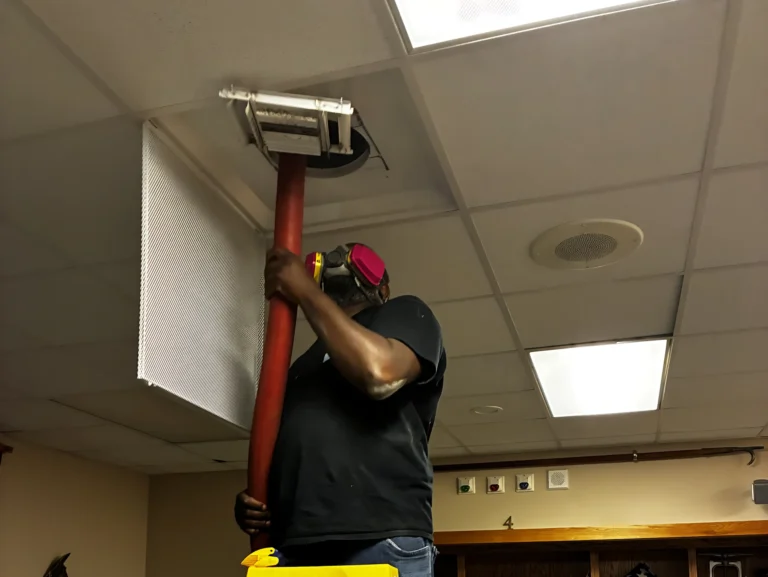
- Drop ceiling access requires removing and replacing ceiling tiles throughout the work area, adding labor time that is proportional to the total duct footage involved
- Duct sections located above finished ceilings in occupied spaces may require evening or weekend scheduling to avoid disrupting business operations, which adds a premium to the base rate
- Commercial properties that have been renovated or repurposed from their original design sometimes have duct routing that does not follow conventional paths, requiring additional investigation and access planning before work can begin
How to Read and Compare Commercial Duct Cleaning Quotes
Receiving multiple quotes for a commercial duct cleaning project is strongly recommended, but comparing those quotes accurately requires knowing what each one actually includes. A quote with a lower number is not necessarily a better value if it covers a narrower scope than a higher-priced alternative.
- Verify What Access Method Is Included: A quote that does not specify how the provider will access ductwork above finished ceilings or in restricted mechanical spaces has likely not accounted for that access in the pricing. Ask specifically what access method will be used and whether drop ceiling work, scaffolding, or lift equipment is included.
- Confirm the Return Side Is Included: Many low-cost commercial duct cleaning quotes cover only the supply side of the system and exclude the return ductwork, air handlers, and return plenums where the most significant contamination typically accumulates. Ask explicitly whether return ducts and air handler cabinets are included in the scope.
- Ask for Before-and-After Documentation: Any reputable commercial duct cleaning provider should be able to tell you exactly how they will document the condition of the system before and after service. If a provider cannot describe their documentation process clearly, that is a meaningful signal about the thoroughness of their work.
- Clarify Whether Component Cleaning Is Included: Coil cleaning, drain pan treatment, and blower cleaning are frequently excluded from base quotes. Understand exactly which components are and are not covered before comparing prices across providers.
- Ask About Containment Protocols: Professional commercial duct cleaning maintains negative pressure throughout the system to prevent dislodged debris from dispersing into occupied spaces. If a provider cannot describe their containment approach in specific terms, their process likely does not include it.
Understanding the Long-Term Return on Commercial Duct Cleaning Investment

Commercial duct cleaning is not a sunk cost. It is an investment with a return that can be measured across several business outcomes, and understanding that return gives facilities managers and business owners a more complete picture of what the service is actually worth compared to its price.
HVAC Efficiency and Energy Cost Reduction
Clean commercial ductwork allows HVAC systems to deliver conditioned air with less resistance and at greater thermal efficiency than duct systems with significant buildup. The U.S. Department of Energy has found that HVAC systems operating through clean duct systems can reduce energy consumption meaningfully compared to the same equipment working through restricted, contaminated ducts. For commercial facilities running HVAC systems across extended daily operating hours, this efficiency improvement translates directly into reduced monthly utility costs that recur with every billing cycle.
Reduced Emergency Repair Frequency
Commercial HVAC equipment that operates within its designed parameters because it is not fighting against restricted airflow, contaminated coils, or blocked drain pans requires fewer emergency service calls and experiences fewer component failures. The mechanical strain that contaminated duct systems place on compressors, motors, and heat exchangers accelerates wear in ways that scheduled duct cleaning directly prevents. For businesses in Fripp Island and surrounding areas that depend on continuous HVAC operation to serve guests or maintain operations throughout the year, this reduction in emergency repair frequency is a significant operational benefit.
Employee Productivity and Reduced Sick Day Usage
Research on indoor air quality consistently links cleaner commercial environments with improved employee cognitive performance and reduced respiratory illness frequency. A commercial duct cleaning investment that improves the indoor air quality of a workplace produces returns in the form of more productive employees who take fewer sick days over the months following the service. These returns are harder to quantify than energy savings but are real and have been demonstrated across multiple workplace studies.
Get a Transparent Quote for Your Commercial Facility Today
Commercial duct cleaning cost is not a number any responsible provider can give you without understanding your specific building, your HVAC configuration, and the current condition of your duct system. What you can expect from a reputable provider is a thorough on-site assessment, a detailed written quote that identifies exactly what is and is not included, and a clear explanation of how each pricing factor applies to your specific facility.
Pro Shine Professional Cleaning works with business owners and facilities managers throughout Fripp Island and surrounding areas to deliver commercial duct cleaning that is transparent in scope, honest in pricing, and thorough in execution. Our team performs detailed pre-service inspections, provides written documentation before and after every project, and ensures that every accessible section of your duct system receives the professional attention it requires. If you are ready to understand exactly what your commercial system needs and what it will cost, contact us today and let us put together a quote built on a real assessment of your facility.


Clean Air Is Just A Call Away!